Highlight
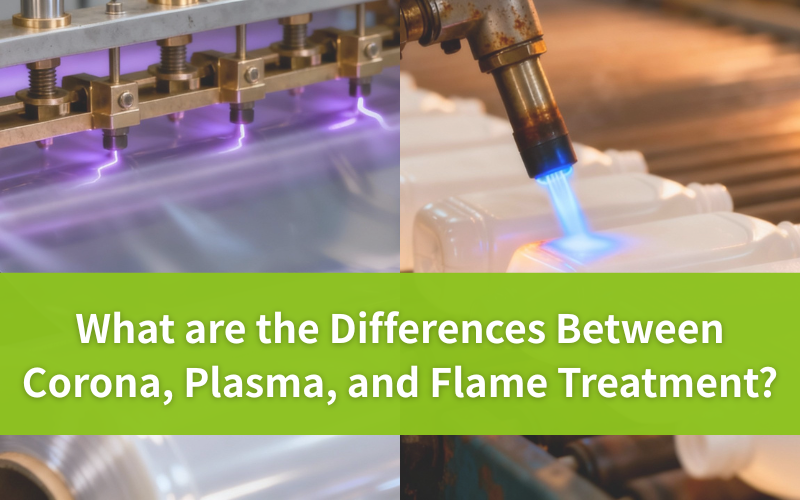
In inkjet printing and industrial coating applications, surface treatment is an important upstream process that affects ink adhesion. This is especially true for low-surface-energy plastics such as PP and PE. Even when an ink has good adhesion properties, insufficient surface energy can still result in ink shrinkage, uneven wetting, poor adhesion, or ink peeling.
The most common surface treatment methods include Corona Treatment, Plasma Treatment, and Flame Treatment. All three are designed to improve the wettability and adhesion conditions of a material surface, but they differ in their treatment mechanisms, suitable materials, equipment costs, and process requirements.
This article compares Corona, Plasma, and Flame Treatment from the perspective of inkjet printing applications and explains how to select a suitable surface treatment method based on different substrates and printing conditions.
Corona Treatment is one of the most commonly used surface treatment technologies in industrial printing. It primarily uses high-frequency, high-voltage electrical discharge to modify the chemical properties of a material surface and increase its surface energy, allowing inks, coatings, and adhesives to wet and adhere to the substrate more easily.
When a material passes between an electrode and a grounded roll, the high voltage ionizes the surrounding air and generates a corona discharge. The resulting reactive species interact with the material surface, introducing more polar functional groups to an originally low-polarity surface. This improves surface wettability and provides better conditions for adhesion.
Common applications include:
For high-speed Roll-to-Roll printing, Corona Treatment is particularly common because it can be integrated directly into the production line to quickly improve the substrate surface condition before printing.
Plasma Treatment is a surface treatment technology that uses reactive particles such as electrons, ions, and free radicals in ionized gas to clean, activate, or modify a substrate surface.
In industrial applications, Plasma Treatment can remove certain organic contaminants from the substrate surface while also modifying its chemical properties. By increasing the concentration of polar functional groups, it helps inks, coatings, and adhesives spread more easily across the substrate surface and improves the conditions for subsequent adhesion.
Depending on the equipment and process, Plasma Treatment can be classified into Low-Pressure Plasma and Atmospheric Pressure Plasma, among other methods.
Plasma Treatment can be used for a wide range of substrates, including:
If a substrate requires not only higher surface energy but also improved surface cleanliness and wettability, Plasma Treatment can be considered as one of the surface treatment options before printing.
However, the final treatment effect is influenced by factors such as substrate type, plasma gas, treatment power, treatment time, and equipment configuration. Therefore, simply knowing that a substrate has undergone Plasma Treatment does not guarantee a specific level of ink adhesion.
Before mass production, it is still recommended to conduct printing and adhesion tests using the actual ink and substrate.
Flame Treatment uses a controlled flame to rapidly treat the material surface, causing an oxidation reaction that increases surface polarity and surface energy.
It is commonly applied to low-surface-energy plastics such as PE and PP, and is particularly suitable for bottles, containers, and certain three-dimensional products that may be difficult to treat using conventional flat-surface Corona Treatment equipment.
Common applications include:
It is important to note that Flame Treatment involves thermal energy. For heat-sensitive substrates, treatment speed and flame distance must be carefully controlled to reduce the risk of material deformation or damage.
All three surface treatment technologies can improve printing conditions on a material surface. However, there is no single method that is universally the best.
When selecting a treatment method, factors such as substrate type, workpiece shape, production speed, adhesion requirements, and equipment cost should be considered together.
In simple terms:
High-speed film printing → Consider Corona Treatment first
Multiple substrate types / complex surfaces / high adhesion requirements → Plasma Treatment can be considered
PE and PP bottles / containers / three-dimensional plastic parts → Flame Treatment can be considered
However, before mass production, testing should still be conducted using the actual substrate, ink, and equipment.
The relationship between surface treatment and inkjet printing mainly comes down to surface energy and wettability.
When the surface energy of a substrate is too low, liquid ink may not spread evenly across the surface, resulting in ink shrinkage, cratering, or localized poor wetting. Even after UV curing, the ink film may still have insufficient interfacial bonding with the substrate.
Proper Corona, Plasma, or Flame Treatment can help improve:
If you are evaluating UV inkjet applications for different materials, you can learn more about CHROMOINK`s LED UV Curable Ink to understand the characteristics of LED UV ink for different materials and industrial printing applications.
After Corona, Plasma, or Flame Treatment, the treatment result should not be judged simply by whether the substrate has been treated or not. More importantly, it is necessary to confirm whether the substrate surface has achieved a suitable wetting condition for subsequent printing or coating.
In industrial applications, Dyne Test Ink or a Dyne Pen is commonly used to evaluate the wetting tension of a substrate surface and provide a quick way to compare the surface condition before and after treatment.
In general, a higher Dyne Level indicates that a test liquid with a specific surface tension can more easily wet the substrate surface. Therefore, it can be used as a preliminary reference for evaluating surface treatment performance.
However, it is important to note that:
Dyne Level cannot be directly equated with ink adhesion.
Even when two substrates have similar Dyne values, their actual adhesion performance after printing may still be different because UV ink adhesion can also be affected by the following factors:
Therefore, the Dyne Test is more suitable as a surface treatment and process monitoring indicator rather than the sole basis for determining whether ink adhesion is acceptable.
Before mass production, formal adhesion and durability testing should still be conducted under actual printing conditions.
%20(1)_cr.webp)
Regarding the relationship between surface wettability, surface energy, and adhesion, you can refer to Fraunhofer IFAM`s technical information on Testing of Surface Wettability.
For PE and PP films, you can also refer to ASTM D2578-23 – Standard Test Method for Wetting Tension of Polyethylene and Polypropylene Films. This standard uses test liquids with specific surface tensions to evaluate the wetting tension of films and can serve as one of the references for surface treatment and subsequent printing, coating, or bonding processes.
When selecting a surface treatment method, the equipment itself should not be the only consideration. The substrate, product shape, production speed, and final adhesion requirements should all be evaluated together.
First, identify the material, such as PE, PP, PET, PVC, ABS, glass, or metal, as well as its heat resistance, surface coating, and surface condition.
Even materials that appear similar may have different surface chemistries. Therefore, directly applying the same surface treatment parameters used for another material is not recommended.
Films and flat materials are generally easier to integrate with Corona Treatment equipment. For complex three-dimensional structures, Plasma or Flame Treatment can be further evaluated.
The process requirements for high-speed Roll-to-Roll production are different from those for single-piece industrial inkjet printing.
In addition to treatment performance, it is important to consider whether the surface treatment equipment can match the existing production line speed and avoid becoming a production bottleneck.
If the finished product will subsequently undergo bending, scratch resistance, alcohol rub, outdoor exposure, or other durability tests, these requirements should also be incorporated into the selection of the surface treatment and ink.
For more information about LED UV printing and curing principles, you can read CHROMOINK`s What Is LED UV Printing? Unveiling the Secrets of Modern Printing Technology.
From an industrial inkjet perspective, increasing surface energy does not necessarily mean that adhesion problems will be completely solved.
The primary function of Corona, Plasma, or Flame Treatment is to create surface conditions that are more favorable for ink wetting and interfacial bonding. However, the final adhesion performance of printed ink is actually determined by the combination of:
Substrate × Surface Treatment × Ink Formulation × Curing Conditions
For example, even when the material is the same type of PP, different suppliers may use different additives, surface coatings, and molding conditions. Therefore, even if two PP substrates have similar Dyne Levels, their actual adhesion performance after printing may still be different.
In addition, some treated plastic materials may experience Treatment Decay, meaning that the surface condition gradually changes after treatment. Depending on storage time, temperature, contamination, and molecular rearrangement at the surface, the surface energy may gradually decrease.
Therefore, when evaluating industrial UV inkjet applications, CHROMOINK recommends the following testing logic:
Confirm the substrate → Measure the surface condition → Select the surface treatment method → Test print → UV cure → Conduct adhesion and durability tests
Rather than simply setting a specific Dyne Level and using it to determine whether a substrate is suitable for mass production.
For new substrates or new inks, a more reliable approach is to conduct testing using the actual production substrate, ink, and printing equipment, while recording the surface treatment conditions as process parameters. This helps establish consistent and repeatable printing quality.
Corona Treatment, Plasma Treatment, and Flame Treatment are all designed to improve the surface condition of materials, but their equipment, treatment mechanisms, and suitable applications are different.
Corona Treatment is suitable for high-speed film printing and continuous production. Plasma Treatment provides greater flexibility for different materials and process conditions. Flame Treatment is commonly used for PE, PP, and three-dimensional plastic products.
For inkjet printing, the goal is not simply to choose the "strongest" surface treatment. More importantly, the treatment should be integrated into a complete process that is suitable for the substrate, ink, curing conditions, and final quality requirements.
Only through actual material testing, surface condition monitoring, and adhesion verification can manufacturers reduce the risks of ink peeling, ink shrinkage, and unstable quality during mass production.
There is no single method that is suitable for every substrate.
Corona Treatment is commonly used for films and high-speed production. Plasma Treatment can be considered for complex shapes or materials requiring more precise surface activation. Flame Treatment is commonly used for PE and PP containers and three-dimensional plastic parts.
The final result should still be confirmed through testing with the actual ink, substrate, and printing equipment.
Not necessarily.
Poor UV ink adhesion may be related to substrate surface energy, surface contamination, ink formulation, ink film thickness, UV curing energy, or the use of Primer.
Surface treatment is one method for improving adhesion, but before adding an additional treatment process, the actual cause of the adhesion problem should first be identified.
There is no fixed period that applies to all substrates.
For some plastics, the surface condition may change over time after Corona or Plasma Treatment. Therefore, printing is generally recommended within a time range that has been validated through the manufacturing process.
If the material needs to be stored for an extended period, it is recommended to recheck the Dyne Level before printing and conduct actual wetting and adhesion tests.