Highlight
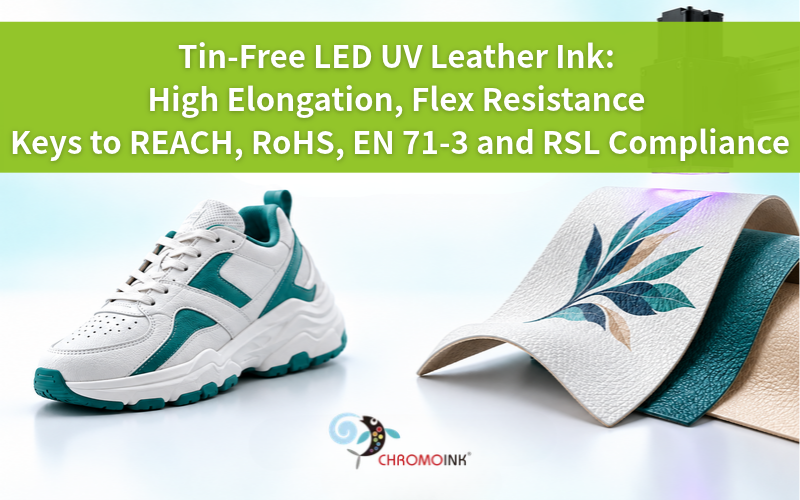
For footwear and leather manufacturers, brand requirements for restricted substances are another part of material selection. CHROMOINK LED UV Tin-Free Leather Ink is designed for footwear materials, leather, and flexible substrates, with organotin-free and high-elongation formulation options.
Understanding tin-free leather ink starts with the role of organotin compounds. Organotin compounds contain a direct bond between tin and carbon atoms. Some are used as plastic stabilizers or catalysts in polymer manufacturing, including certain PU resin and coating processes. Organotin compounds may therefore be present in related raw materials or processing materials. However, they are neither present in every leather ink nor essential to LED UV curing.
Some organotin compounds pose environmental and health hazards. For example, tributyltin may accumulate in aquatic organisms after entering water and disrupt their endocrine and reproductive functions. Information on tin and its compounds from Taiwan’s National Environmental Health Research Center also notes that certain organotin compounds may affect the brain and nervous system. The actual hazard depends on the compound, concentration, and route of exposure. All tin-containing substances should not be treated as having the same hazards.
Organotin-free leather ink formulations aim to avoid the use of relevant organotin compounds and incorporate restricted substance management into raw material selection and process control. This helps address the REACH restrictions on organotin compounds published by the European Chemicals Agency (ECHA), as well as brand Restricted Substances List (RSL) requirements. The AFIRM RSL provides a reference for the apparel and footwear supply chain. Actual compliance must still be confirmed against the customer’s specified version, product code, and test documentation.
LED UV Tin-Free Leather Ink combines this formulation approach with LED UV curing technology. Exposure to a compatible light source cures the ink, forming a printed layer on leather or footwear materials. When “tin-free” refers to organotin-free formulations, it does not necessarily mean the complete absence of every form of tin. Adhesion, elongation, and flex resistance must also be evaluated under actual substrate and processing conditions.
Leather and footwear printing requires a balance between material requirements, production efficiency, and finished-product durability. Footwear uppers undergo stretching and repeated flexing during forming and wear. The printed layer must also withstand finishing processes such as lamination and topcoating. Ink selection should therefore consider curing, flexibility, adhesion, and workplace conditions alongside color performance.
From a material management perspective, certain organotin compounds have hazards associated with aquatic environments or reproductive health. REACH restricts specific compounds and uses, while footwear and apparel brands may include organotin requirements in their RSLs. CHROMOINK’s Tin-Free organotin-free series supports the management of these restricted substances. Actual compliance must still be confirmed for the specified product, application, and test documentation.
The following characteristics are closely related to production requirements when evaluating LED UV Tin-Free Leather Ink:
Curing efficiency: Adequate curing affects the condition of the printed layer and subsequent processing. LED UV ink cures when exposed to a compatible light source. Actual curing speed must be evaluated together with the light source, ink laydown, and equipment settings.
Flexibility and flex resistance: Footwear uppers and leather goods deform repeatedly during use. Insufficient flexibility may cause cracking or peeling. Ink elongation and flex resistance should be assessed on the actual materials.
Substrate adhesion: Poor adhesion may cause graphics to detach during lamination, topcoating, or use. PU, PVC, genuine leather, and different coatings have different surface properties. Performance should be verified through the complete processing sequence.
Odor and workplace conditions: Printing and cleaning involve operator exposure and ventilation management. Low odor may be considered during evaluation, but it cannot replace VOC or exposure assessments. Handling and protective measures should follow the Safety Data Sheet (SDS) for the specific product.
Footwear uppers and flexible leather undergo stretching during lamination, forming, and wear. The printed layer needs to stretch with the material. Insufficient elongation may lead to cracks that affect the appearance and integrity of the graphics.
CHROMOINK LED UV Tin-Free Leather Ink offers a stated elongation performance of up to 300%, combining stretchability with adhesion to support the processing requirements of footwear uppers and flexible leather.
Footwear uppers bend repeatedly during walking, and the printed layer must deform with the material. Insufficient flex resistance may cause cracking or peeling after prolonged use. Flex resistance is therefore an important indicator when evaluating footwear print durability.
CHROMOINK LED UV Tin-Free Leather Ink offers a stated performance of more than 100,000 flex cycles without cracking. It is intended for footwear uppers, leather, and flexible substrates that undergo repeated bending. The LED UV Tin-Free Leather Ink testing video provides a reference.
Actual elongation and flex test results depend on the substrate, coating, ink layer, and curing conditions. The CHROMOINK R&D team tests actual materials and evaluates adhesion, cracking, and peeling against customer acceptance criteria to confirm suitability for processing and finished-product requirements.
Editorial note: Replace the image with the YouTube Shorts video.
Footwear materials and leather goods used outdoors are exposed to sunlight, rain, and temperature changes. Insufficient weather resistance may lead to fading or changes in the printed surface, affecting graphic clarity and product appearance. Alongside elongation and flex resistance, weather resistance is an important consideration when evaluating leather and footwear inks.
CHROMOINK LED UV Tin-Free Leather Ink offers a stated outdoor durability of more than two years, providing a formulation option for footwear materials and leather goods that require both flexibility and outdoor durability. Actual performance depends on ink color, substrate, coating, curing conditions, and the service environment. Testing should be arranged according to the intended application.
For an example of weather resistance evaluation, refer to CHROMOINK’s article on outdoor billboard durability. The article reports that LED UV ink underwent 864 hours of QUV accelerated weathering testing, with a maximum color difference of ΔE ≤ 5.
Provide the complete printer and printhead model numbers, then review the ink’s Technical Data Sheet (TDS), ink supply system materials, LED light source, ink laydown, and cleaning procedures. CHROMOINK’s LED UV Tin-Free Leather Ink product information lists selected Epson, Konica, and Ricoh printhead series. However, a series name alone does not confirm compatibility with a specific printer.
Before changing inks, confirm how the existing ink and cleaning fluid should be handled. Keep records of ink line cleaning and the initial nozzle condition. If the cured surface remains tacky, adhesion is insufficient, or nozzle problems occur, these records can help identify issues involving ink laydown, the light source, materials, or cleaning procedures.
PU-coated synthetic leather, footwear uppers, bags, and other flexible substrates are potential materials for leather ink trials. In a footwear upper factory, materials may undergo surface treatment, digital printing, topcoating, cutting, and shoe assembly. Evaluation should extend beyond the color immediately after printing to include adhesion, flex resistance, and graphic appearance after the planned finishing processes.
PU coatings and surface treatments from different suppliers may produce different results. Even when materials share the same name, testing should use the actual production materials.
These four frameworks have different scopes and purposes. They should not be grouped together as a single universal “safety certification.” An organotin-free formulation is a material characteristic; it does not automatically establish full compliance with REACH, RoHS, EN 71-3, or every brand’s RSL.
Item | Materials or Applications That May Be Subject to Relevant Requirements |
Leather, PU/PVC synthetic leather, footwear materials, textiles, and coated materials supplied to the EU. Applicable restrictions must be checked according to the substance, use, and product category. | |
Plastic housings, cables, coatings, and printed materials used in electrical and electronic equipment within its scope. Ordinary footwear materials and leather goods are not covered solely because of their material composition. | |
EN 71-3 | Plastic, textile, leather, and printed coating materials used in toys. Migration of certain elements must be evaluated within the scope of the standard. |
RSL | Leather, synthetic leather, textiles, plastics, coatings, and printed materials used in branded footwear, apparel, bags, and accessories. Requirements must be checked against the customer’s specified list. |
Applicability depends on the material, final product use, sales market, and brand requirements. It cannot be determined from the material name alone.
Requirements for finished products must also be checked separately for each Southeast Asian market. For example, Singapore’s consumer product safety rules cover toys, children’s products, and apparel. Indonesia’s national standards body lists SNI ISO 8124-3, which addresses the migration of certain elements in toys. These references help identify what should be checked, but requirements for an individual finished product still depend on the country of sale and product category.
Poor adhesion: Check the substrate surface, coating, ink layer, and curing conditions.
Cracking during flexing: Review the material combination, ink layer thickness, and finishing processes.
Tacky surface: Record the light source settings, printing speed, and ink laydown, then make adjustments according to the product’s technical documentation.
Nozzle problems: Review cleaning, ink supply, and shutdown maintenance records.
Keeping printed samples and recording settings before and after adjustments makes it easier to determine whether a problem relates to materials, equipment, or processing conditions.
No. Compliance must be confirmed against the specific product code, restricted substances, intended use, and supporting documentation.
No. The scope and restricted substance list of RoHS differ from the requirements used to assess organotin compounds.
Not on its own. The tested sample and final product use must be reviewed, along with any additional requirements for the finished product.
PU synthetic leather is a potential substrate for printing trials. However, different surface coatings affect adhesion and flex test results. Evaluation should use actual footwear upper materials after the intended topcoating and finishing processes.
Equipment compatibility should be confirmed first. Introduction into production should then be based on the required cleaning procedures and printing trial results.
Obtain the customer’s specified brand, list version, limits, and test sample requirements, then compare them with the available reports.
Yes. Appropriate ventilation is still required. Low odor does not mean that volatile substances are absent, and odor cannot be used to determine whether handling conditions are safe. Ventilation and protective measures should follow the ink’s SDS and workplace conditions. The U.S. Environmental Protection Agency notes that the term “low VOC” alone does not establish the actual VOC content of an individual ink.